
New Year, New You?
How to stick to your New Years resolutions through neuroscience of habit formation

Hello and welcome to this edition of The NeuroNinja Newsletter!
Action Your Potential (AYP) is all about helping people unlock the gift of themselves – through the transformative power of neuroscience.
If you missed last week’s edition, you can catch up here!
In this edition we delve into the neuroscience of habit formation and how you can actually stick to your resolutions in 2026.
“Do you have any New Years resolutions?”
Is a question you may have been asked, probably in an entirely well-meaning way!
New Year’s resolutions are, on their face, an entirely harmless thing. What’s something you want to change this year*? That could be a better fitness habit, eating habit, emotional hygiene etc.
However, I think theres a certain fakery and defeatism when we talk about New Year’s resolutions. Often, after a discussion about one’s resolutions, comes the killer (and slightly impertinent question of “How long will that last?”.
*Stumped for ideas? We have some for you at the end of this newsletter. Stay tuned 😉
This, and the social pressure around New Year’s resolutions may lead to the fact that only 19%* of Brits say they intend to set a resolution for 2026.
We’ve spoken before about the fundamental reality of neuroscience which is that change is always possible in your neurally plastic brain. Always, no matter how old, set in your ways or difficult you may be finding something. You have the power to change your brain, and thus your world.
So, in this newsletter I am going to iron out a few features of neuroscience, and how they will help you achieve your goals in 2026.
Go big and go home
One of the main hurdles that cause people to ‘fail’ on their resolution is the sheer size of the goal.
Often our goals can be things like “I want to run a Marathon”, “I want to loose a lot of weight”, “I don’t want to be anxious anymore”.
Whilst all of these goals are achievable, they are also not at all quick. (If they were, I daresay you would already be doing them!)
This leads us to one of the fundamental realities of neuroscience, little and often is always the way to go.
Our brains are incredibly powerful biological processing devices. Every single day you fire billions of neuronal pathways in vastly different areas of your brain. You brain gets very very good at firing along these pathways you always use, meaning they become habits.
Habits are things you effectively do on autopilot, you almost take them away from conscious activity. Brushing your teeth is a perfect example of this, you almost certainly brushed your teeth this morning (at least I hope so?!) but you may not even remember doing it.
This is because you do it so so much, your brain fires those neural pathways so readily it doesn’t even need to get your consciousness (your self-aware mind) involved in the process.
Remember, we are NOT IN CHARGE of this system. Our body and our brain build and project our mind everyday. More on this in this edition.
Because of these strongly embedded habits and behaviours, our brain can be hard to change. So we must commit to smaller changes, for longer.
Consistency is key 🔑
Your ability to achieve a certain goal or habit entirely depends on how consistent you are with it. One salad does not make for a healthier person, one run does not make for a marathoner. Instead, small goals on the way to a larger goal are vital.
Let’s do a goal of running a marathon for example (I had to… you know me!)
If you are not a runner at all, this task may seem entirely impossible. But to start with, we don’t even need to think about the marathon. We just need to lace up.
Start by running / speed-walking two or three times a week. Distance doesn’t matter, it’s more about time spend out.
Stick to it, and you are slowly carving new neural architecture into your brain, and your body’s muscles are getting more used to the wear and tear of everyday jogging. Once you have this consistent habit, maybe after 6 weeks, thats when you can start increasing the distance/time of your outings – or perhaps add in another run?
Within a few months, you will have the strong foundations of a running habit, which you can then build on and on until you reach your goal.
Be a little more specific.
Another problems with a lot of New Year’s resolutions is their lack of specificity.
“I want to be happier” is a classic. Okay, amazing - entirely with you… but what does that actually mean?
We need to be super specific with our goals, because then we can break them up into smaller goals and tasks, and allow us to slowly change our routines and habits to achieve them.
So for a resolution to better manage anxiety for example, we must first contend that is impossible to entirely rid yourself of worry – for reasons we’ve outlined in a previous edition.
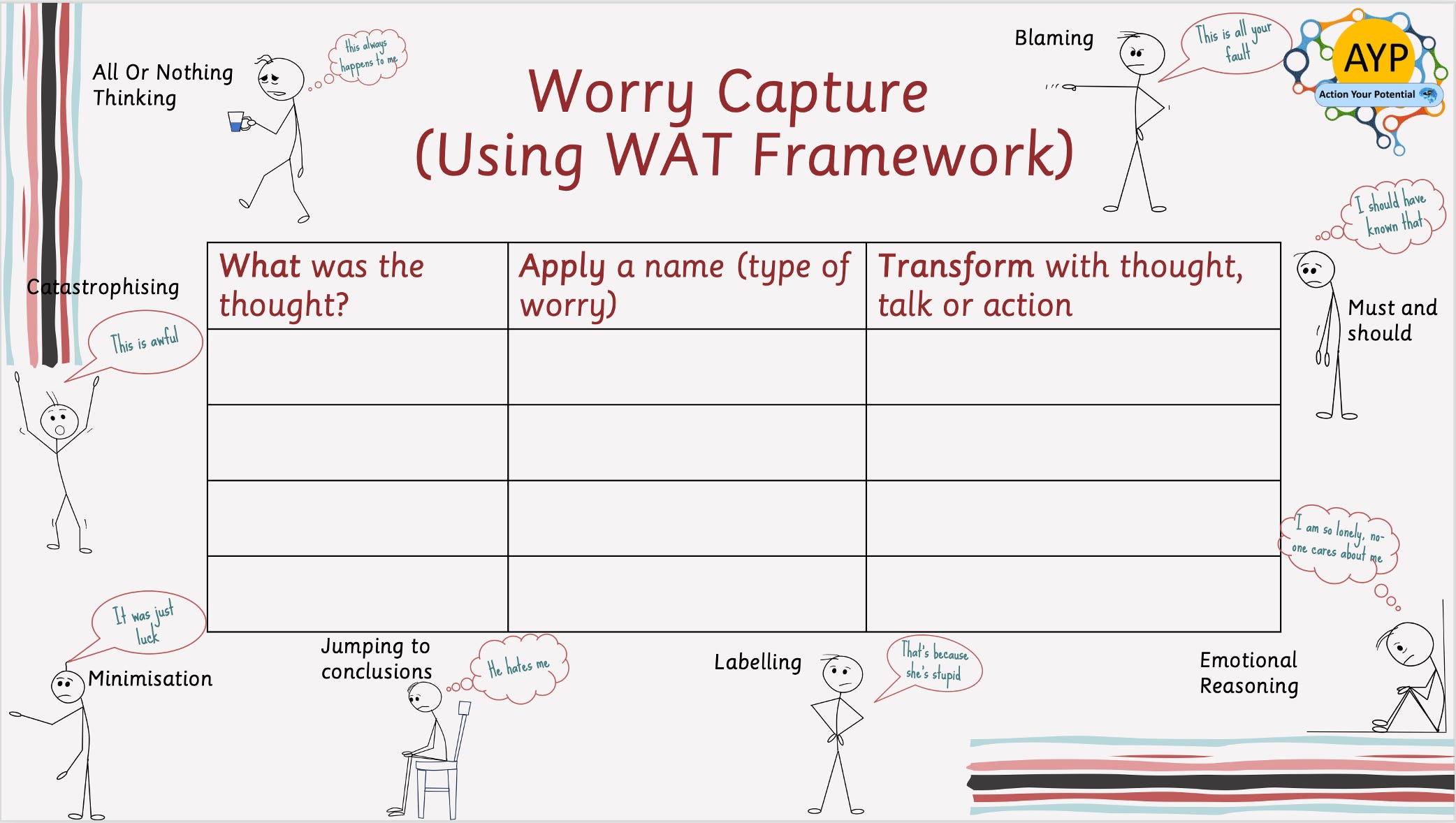
But you can absolutely reduce your feelings of anxiety! The first step is to be more metacognitive, to build the architecture in your neocortex to pull yourself out of your worry system. A crucial first step in this process is noticing a worry, a fear or anxious thought, labelling it and then transforming it.
Below is a handy guide to the ‘WAT Framework’ we use all the time when working on this stuff.
When we say transform, this can take many forms. You could ‘bucket’ the worry – a method we discussed at length in this episode of our podcast!
Another thing you could do is journal, that’s one of my newer habits and I find it really helpful as a way of distilling and releasing worries, thoughts and negative feelings we have
.
So by simply noticing, labelling and transforming our worries, we are literally building the neural architecture to become a less anxious person in the future.
Timelines are important
Because consistency is so important in forming habits, you also need to be super realistic on your achievement timeline.
You are not going to be running a marathon within weeks, you probably won’t even be enjoying running or noticing your anxiety has reduced for at least a month or so.
These things take time, because without realising it over the course of our lives we’ve strengthened the neural architecture we are using everyday – meaning that change is going to be really hard. It’s like rowing a boat against a steam, you are pushing against pre-exising architecture, but your brain can and WILL change if you keep at it.
Accountability people!
To stick to a goal, we also need to be accountable. Did I go for the run I said I would? If not, you gotta make the time to do it.
Consistency is the most fundamental feature of habit formation, because ultimately what you do with your brain it gets better at. If that’s going for runs, or managing and noticing your worries, great – it’s getting better at that!
If it’s procrastinating and spiralling, bad news… you’re getting better at that as well,
You can do it, and you should do it.
Should you set New Year’s Resolutions? Hell, you shouldn’t just wait for New Year.
We can get so swept away in day to day life and certain thinking patterns that we can get lost in it. In this vein I would argue New Year’s is a great opportunity to be a bit metacognitive… to zoom out on your life experience and think about what you want to change and improve.
That is different for everyone. I’m not saying you need to get fitter, or eat healthier, or that your life is fundamentally bad. I frankly have no idea, and we are all different people leading different lives.
But one habit you should absolutely build this year, everyone, is completing your 12 Rocks of Well-Being Every. Single. Day.
You will feel better. It’s literally as simple as that.
The 12 Rocks of Well-Being are the 12 neuroscience approved daily behaviours that will make you feel better everyday. Over the coming weeks we’ll do pieces on each of the rocks, how they work and – crucially – why, but for now I guarantee you will feel better if you start making sure you complete these things everyday.
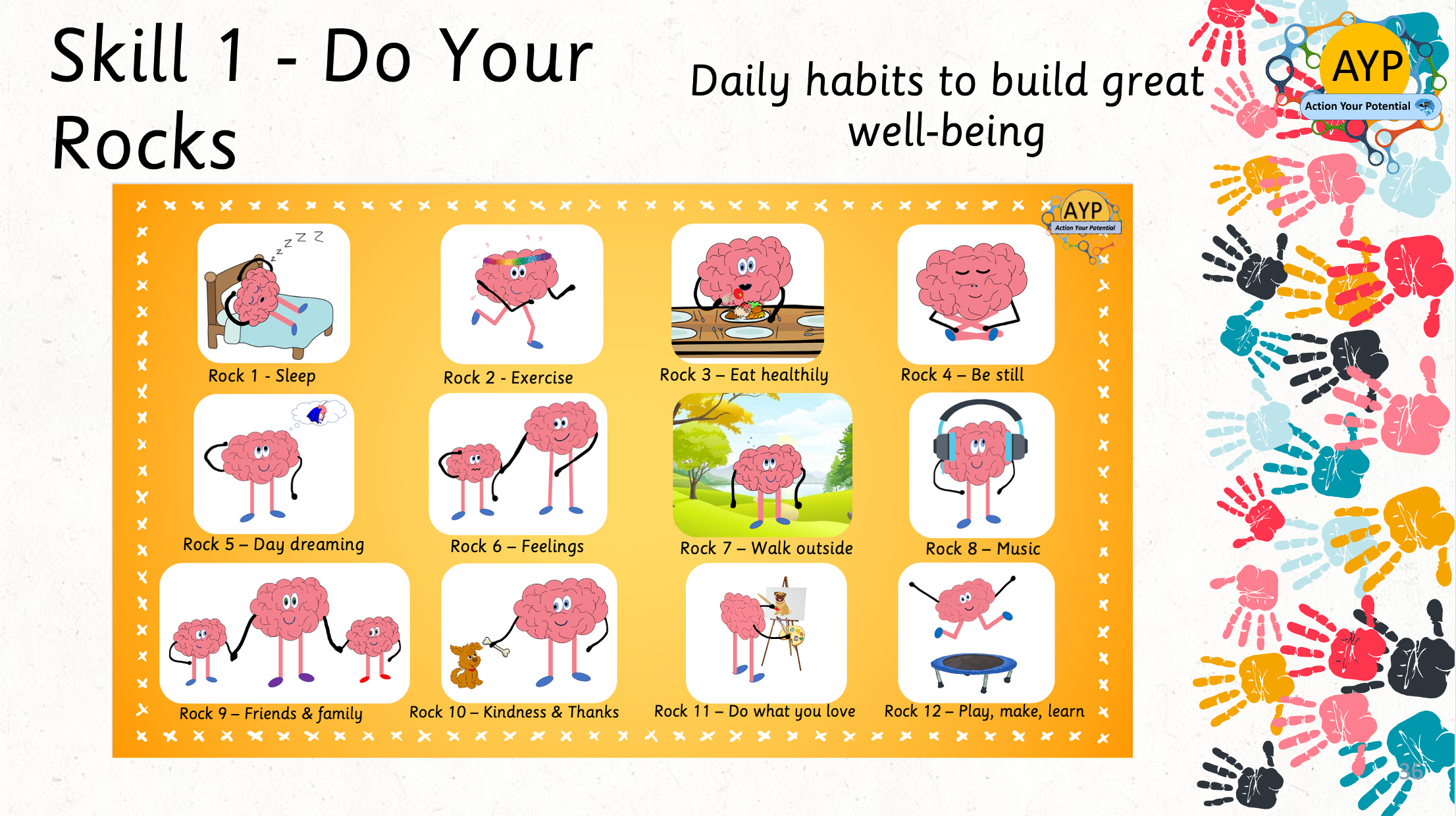
Because accountability is super important, we’ve made it hella easy with our free NeuroNinja App, where you can track your 12 Rocks every day.
You can download the Be A NeuroNinja App on the Apple App Store or the Google Play Store for free, today!
Thank you very much, you clearly like a bit of brain science!
You can keep the neuro-natter going by:
🎧 Listening to our podcast!
Our show is available on all major podcast platforms!
👀 Watching our podcast!
We upload our full episodes to Youtube, so subscribe today!
📲 Getting us into your feeds!
Follow us on social media!
📜 Subscribing to this newsletter!
Join the hundreds of people who read this newsletter every Friday! Just click the button below to subscribe for free.
Thank you for reading this edition of The NeuroNinja Newsletter!
Neuro Ninja Newsletter was written by Adam Wright. Edited by Angela Wright.