
You have evolved to worry
We have all evolved with an extremely powerful worry system. That ISN'T ALWAYS a bad thing.

Hello and welcome to this edition of The NeuroNinja Newsletter!
Action Your Potential (AYP) is all about helping people unlock the gift of themselves – through the transformative power of neuroscience.
If you missed last week’s edition, you can catch up here!
In this edition we’re going to talk more about our worry system, and the types of worries it can generate.
You have evolved to worry.
This frankly blew my mind when I first discovered it. Over thousands and thousands and thousand and thousands (and thousands and thousands and thousands… etc) of years we have evolved a part of our brain whose job it is to absolutely freak us out on a daily basis.
A crucial part of this worry system, as we call it, is the Amygdala. One of our Amygdala’s primary foci is the identification and actioning of perceived threats, shifting our body into our fight, flight, freeze response when it ‘encounters’ one. The amygdala spots change in the environment. Change can be positive or negative and the amygdala spots both. Our focus in this newsletter is on the negative.
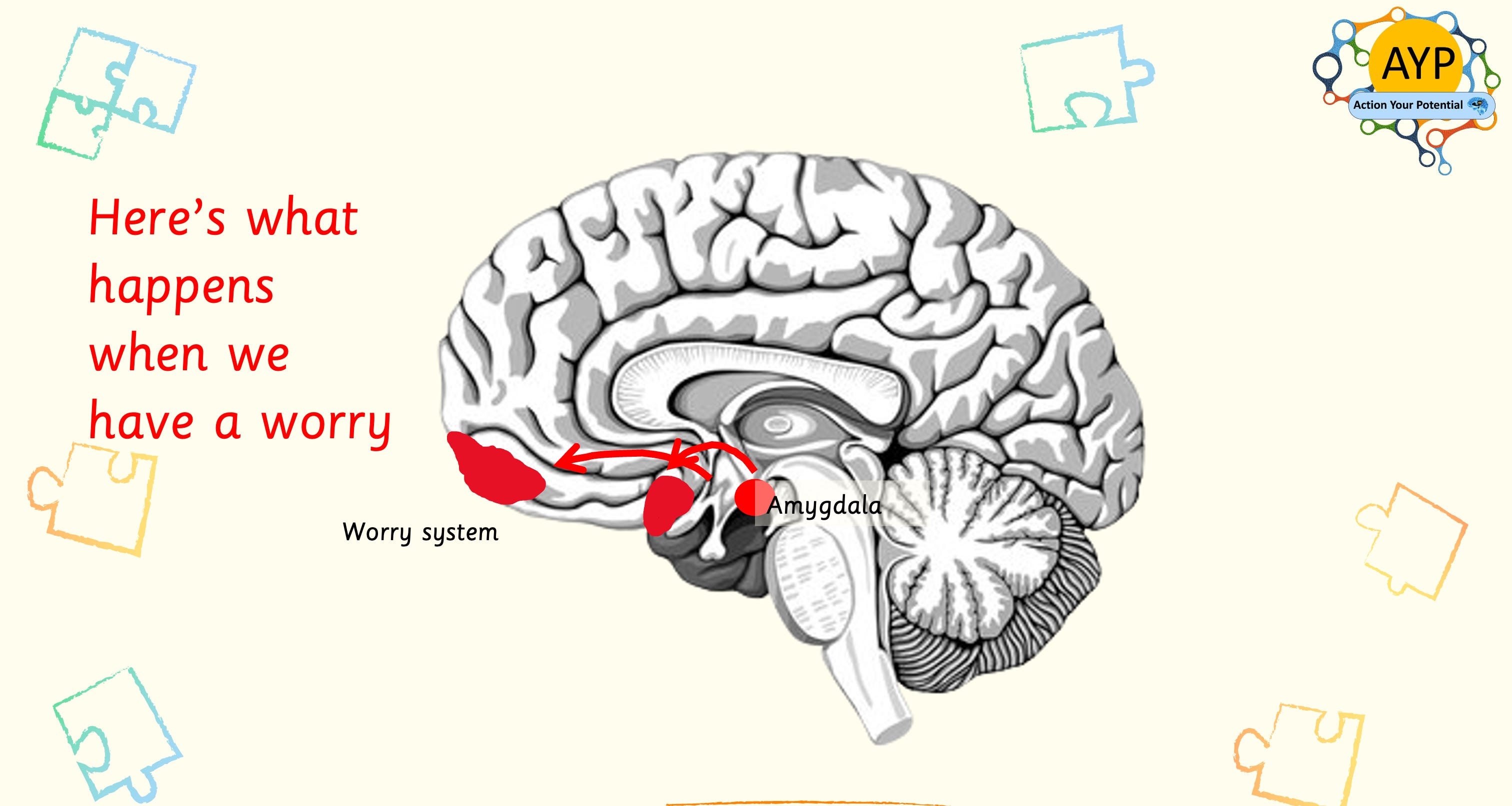
We speak about worries a lot at AYP, as they are a pretty fundamental part of our mind’s experience every day.
Indeed, in the newest series of our podcast AYP Spike we’ve already covered a couple aspects of our worry system in more detail.
Watch episode two: “Why do I worry?
Watch episode nine: “Worry Buckets”
But the fundamental reason why we have evolved a worry system is for protection and self-defence.
Evolution by natural selection, baby
To simplify it, if i’m a caveman walking through a forest and I hear a rustle in the bush, a twig snap… if I immediately react as if it’s a sabre-toothed-tiger and run away – I would likely be okay. Crucially, I would very likely be okay EVEN IF it wasn’t actually the threat that I perceived it could have been. However if I was just casually dismissing it and carrying on picking my berries, and it WAS a sabre-toothed tiger then bye-bye to me.
So running away means I would have been able to pass down this worry-based disposition to future generations.
Evolutionarily, having an extremely powerful and fast worry system was a huge factor in our day-to-day survival. However, this powerful negative-prediction-based response is not always helpful in the modern world…
Freaking out in a meeting isn’t particularly helpful, as it isn’t when we’re dealing with a tricky family relationship, upcoming test etc.
So we need to first of all understand that our worry system will activate, and it will activate powerfully all the time.
Here’s me explaining this idea again, in about 93 seconds.
So, my worry system is a bit of a drama queen?
Yes, and no.
Your worry system is trying it’s best to keep you safe. This does mean a lot of the time it may perceive threats when there aren’t any there, especially when our brains are lacking enough information to build an accurate model.
This is why you’ve probably at some point been suddenly awoken because you thought a coat hanging on a chair was a stranger in your house. Our brains will powerfully predict negatively to try and keep us safe.
In truth a lot of the time, this is UNHELPFUL. And to make it worse, we won’t even realise that’s what’s happening. Our brains are so powerful they fully convince us that the negative worry and threat it’s predicting is as real as it is imminent.
When you first saw that coat on a chair, you SAW a person, your brain made you see a person.
So these powerful negative predictions are sometimes not only not realistic problems, they are complete falsehoods.
In future editions I will delve deeper into how we can sort and manage these specific types of worries, but today I want to take the stand FOR the worry system.
I hate being worried. Can’t I just get rid of it?
Now, this would be a very bad idea. First of all I should say that everyone will and does worry, in different capacities of course.
Some people’s worry systems, due to a lack of management and/or lots of tricky traumatic experiences are stronger than others – meaning they may struggle with some of these issues more. This is an extremely upsetting place to be in, and we need to, as early as possible, being to reign in that worry system*.
(*If you or someone you know is struggling with an overactive worry system… we can help. Get in contact today on our website.)
However, to fully just remove and get rid of it isn’t a great plan either. (Clearly, we wouldn’t even be able to just get rid of it – but run with the thought experiment.)
The case for the defence
Argument one
Your worry system is still extremely effective at keeping you safe. Your worry system activates when crossing the road, making sure you check left and right before doing so. Your worry system helps you to drive safely, makes sure you don’t walk too near to a cliff edge, and ensures you’re careful around kitchen cutlery.
These are worries that kind of get to the system’s original evolutionary purpose – to protect you from physical threat or harm.
However, our worry system can also be helpful in more emotional situations
Argument two
Your worry system is the part of your brain that reminds you to set your alarm on your phone the night before the big meeting. It’s also the system that reminds you to pre-pack your bag a night before a big trip, to ensure you have everything. Your worry system kicks in to remind you to turn the oven off, lock the front door and remember your P.E. Kit.
In truth we are worrying about these things because we are often catastrophising about the consequences of such actions… but the result is that we can often generate what we term Realistic Worries. These are, as the name implies, worries that are fabricated, and in fact – are ones we can do something about.

So while it’s easy to see our worry system as a nuisance – or a full-time drama queen – it’s actually a finely tuned survival tool that’s simply operating on rather outdated settings. The real challenge isn’t to rid ourselves of it but to understand it, appreciate its intentions, and guide it into being a wiser, calmer part of our everyday lives.
There’s a lot more to say on our worry system and the complicated and highly upsetting ways it operates. Stay tuned and subscribe for more newsletters on the topic, coming to an inbox near you soon 🔜👀
Thank you very much, you clearly like a bit of brain science!
You can keep the neuro-natter going by:
🎧 Listening to our podcast!
Our show is available on all major podcast platforms!
👀 Watching our podcast!
We upload our full episodes to Youtube, so subscribe today!
📲 Getting us into your feeds!
Follow us on social media!
📜 Subscribing to this newsletter!
Join the hundreds of people who read this newsletter every Friday! Just click the button below to subscribe for free.
Thank you for reading this edition of The NeuroNinja Newsletter!
Neuro Ninja Newsletter was written by Adam Wright. Edited by Angela Wright.