
Journaling literally changes your brain!
The simple act of writing down your thoughts and feelings has an insane transformative impact on how you feel.

Hello and welcome to this edition of The NeuroNinja Newsletter!
Action Your Potential (AYP) is all about helping people unlock the gift of themselves – through the transformative power of neuroscience.
If you missed last week’s edition, you can catch up here!
In this edition we discuss journaling – and why you should be doing it every day!
“Not for me, that.”
This was literally how I felt about journaling, up until a few months ago.
Not that I wasn’t pro-journal! I’ve always held the view that it was really helpful for people who maybe struggled to articulate themselves and their feelings.
I’ve always been a fairly emotionally articulate person, heart on my sleeve and all that, so I just didn’t think it was something I needed to bother with.
However, during a rather chaotic 2025 – I decided to try and create a journaling habit, and it’s been great!
Let’s not exaggerate anything here.
Whilst the impact of journaling is profound in the brain, (the title is no lie!) its effect on us in the moment does not equate to all our problems dissolving away.*
See last week’s Substack for a takedown of ‘quick and simple’ solutions. Read here:
But journaling has benefits for literally everyone, no matter how emotionally articulate you feel yourself to already be. To see why all we have to do is zoom and have a look under the hood of your brain.
Journaling = Movement*
*Not literally, unless you journal whilst walking which I have to say... is rad.
Our brains constantly fire numerous different neural pathways throughout the day as we do all the different things we need to do. The vast majority of this activity is done subconsciously – you aren’t manually in control of your heart rate, your digestion etc.
Different parts of your brain broadly do different things*…
No, that doesn’t mean you only use 10% of it. We made a video explaining why that is, which you can watch below.
… and this means when we are doing different things, our brain activity is fairly localised to certain areas.
So, if we are having a tricky emotional experience – we’re maybe running down a spiral of worries – we are localising our brain activity in the ‘worry system’ just behind our eyes and the bridge of our nose.
This isn’t a fun space to be in, yet we may not even realise that’s where we are. It sounds silly, but you often don’t even realise that you’re worrying when in these spaces.
It gets worse! Neuroplasticity teaches us that whatever we do the most in our brains we end up practicing – including negative things.
So our worrying spirals end up strengthening and mean in the future we can find it even harder to break out of them.
This is where journaling comes in.
Very basically, the act of journaling uses a completely different part of our brains. This bit can be found at the top, just under most peoples hairlines. The pre-frontal cortex, or as we are going to refer to it – the insight circuits – are where we can find skills like patience, kindness, perseverance etc.
Our insight circuits are also where we can tap into a process called ‘metacognition’.
Meta-whatnow?
Fear not, there will be a whole future edition on metacognition – but for now suffice to say that metacognition is our brain’s ability to sit above and look across the activity of the brain.
This process allows us to trace emotions to events, to catch worries in the act and provide ourselves some perspective.
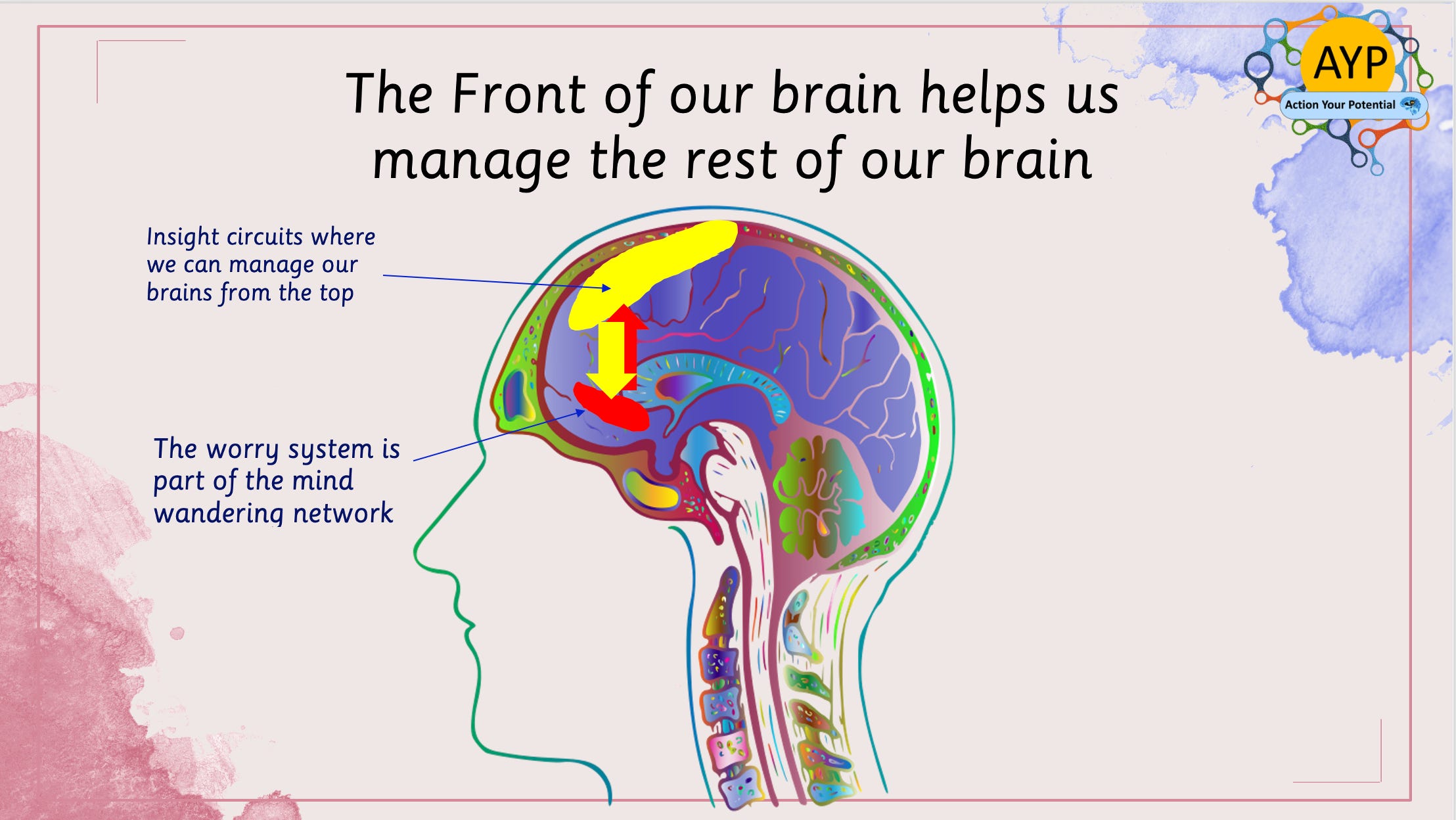
Journaling basically utilises this process, moving our brain activity from one part of our brain to another. It is impossible to journal effectively without sitting above and catching your emotions, so this effect is inherent within the process of journaling.
Journal it all, but especially the good stuff.
Now that I’ve totally convinced you to journal daily – (you’re welcome, by the way 😉). I just wanted to mention one more aspect of journaling which is super important – the content of our entries.
Now, it is super duper (wuper, squper etc) important to write down negative thoughts, worries, experiences in our journals. Absolutely. However, make sure you are not only writing these experiences down.
This is because it can provide us a false view that only negative things happened to us on a certain day – and worse if we go back to previous journal entries we can discover that we “actually always feel miserable, low and moody” which isn’t true!
So, as well as the tricky experiences of your day to day life, make sure you write down some good ones.
GLADEN it up, buttercup.
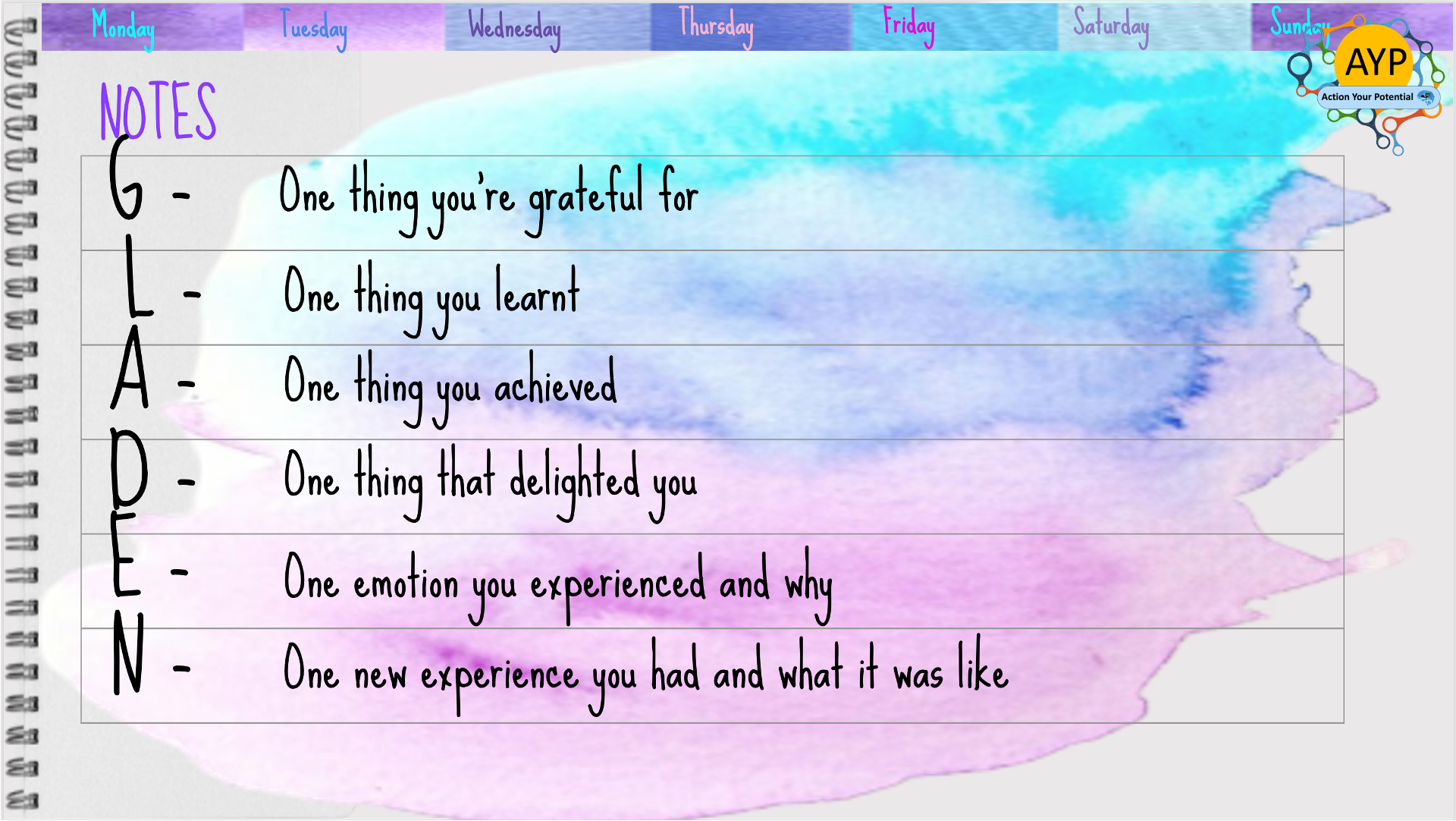
We like to use the acronym G.L.A.D.E.N at Action Your Potential. It doesn’t replace your journal entries, but they are things you should absolutely aim to include.
G - One Thing You’re Grateful for…
Every day things happen that you should be grateful for. Weather thats your dog’s waggy tail, the city you live in, etc etc. Search for the gratitude in your day.
L - One Thing You Learnt…
Every day is a school day! So what did you learn today? Struggling for one today, well I can inform you that barcode scanners actually scan the white bit, not the black! You’re welcome (again!) ;)
A - One Thing You Achieved…
From small things like making a nice breakfast, to big things like completing a workout, you achieve lots every day!
D - One Thing That Delighted You…
We need more delight in our lives (especially of the Angel variety!) It could be Carlos Alcaraz’s amazing grand slam victory, or a coffee with an old friend.
E - One Emotion You Experienced…
What emotions did you feel today, and what caused them.
N - One New Thing…
Novelty is a powerful thing for our brain, so what new experience did you have?
It may seem like a lot, and some of you may even be questioning whether all that stuff actually happens in your day to day life…
But that’s part of the power of it. I can guarantee you that all those things happen to you every day.
And, in even better news…
…if we search for the good in every day, our bestie neuroplasticity will help us to get better and better at spotting and experiencing the joy and happiness in each day. Now we’re talking!
To put it simply: the more you journal about it, the better you will get at noticing and spotting it. So why not notice the things that make you happy?!
You: Thanks Adam. Really enjoyed that.
Me: Thanks.
You: You really are putting the lit in non-fiction literacy. 🔥
Me: You are too kind 🥹
You: But I want more! Specifically, in video and audio form for me to listen to whenever I fancy!
Me: Well, do I have some good news for you!
Our game-stabilising podcast One Brain At A Time releases every Monday!
Join myself and Andy Feist as we cram some life changing neuroscience into highly respectable 30 minute episodes!
In our latest, we discussed why YOU’LL NEVER BE TRULY HAPPY!
No, really… but not in a mean way I promise!
Join Andy and myself to discovery why your brain really isn’t interested in happiness, and how to search for it in everyday life
You can watch the episode below.
… and listen wherever you get your podcasts! 🎧
Our show is available on all major podcast platforms
📲 we’re on social media too!
Follow us on social media!
📜 Why not subscribe, whilst you’re here 😉!
Join the hundreds of people who read this newsletter every Friday! Just click the button below to subscribe for free.
Thank you for reading this edition of The NeuroNinja Newsletter!
The NeuroNinja Newsletter was written by Adam Wright. Edited by Angela Wright.