
How to co-regulate your child
What is co-regulating and how it profoundly affects the development of your child.

Welcome to the Neuro Ninja News Substack! Every Wednesday we’ll break down some complex neuroscience into a short and easy read, sent straight to your inbox!
Need more neuroscience? Check out our website for more on our mission to save the world, one brain at a time.
Parenting matters.
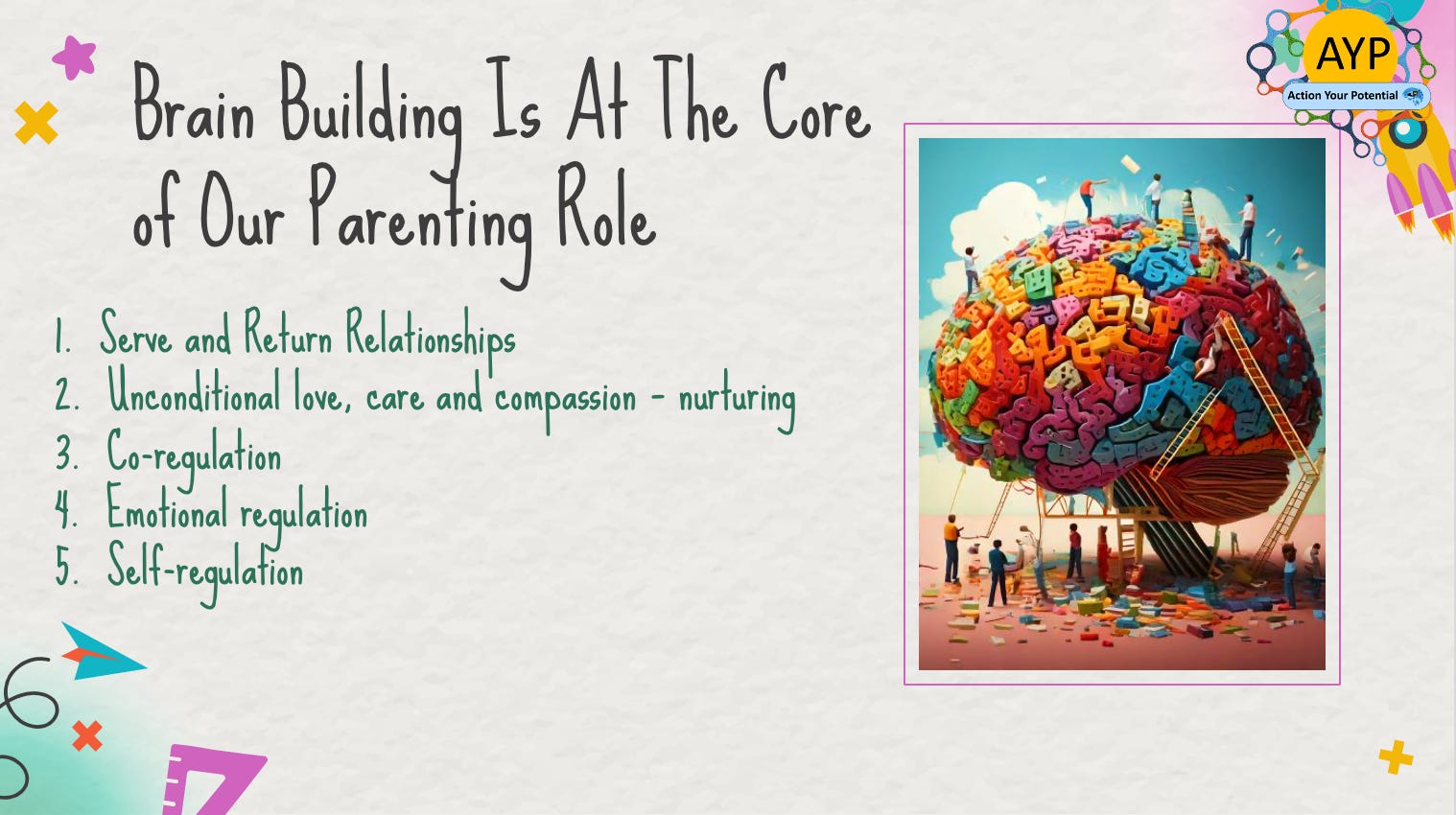
Human brains are literally built because through their development experiences. Our mission as parents is to support our children to arrive at maturity in their middle-twenties with balanced neural architecture and skills of effective self-regulation and executive function.
Self-regulation refers to the process whereby we can ultimately take action to soothe ourselves when under assault from the stresses and strains of life. The ability to regulate our nervous system is a subtle sequence of skills available to us as we mature.
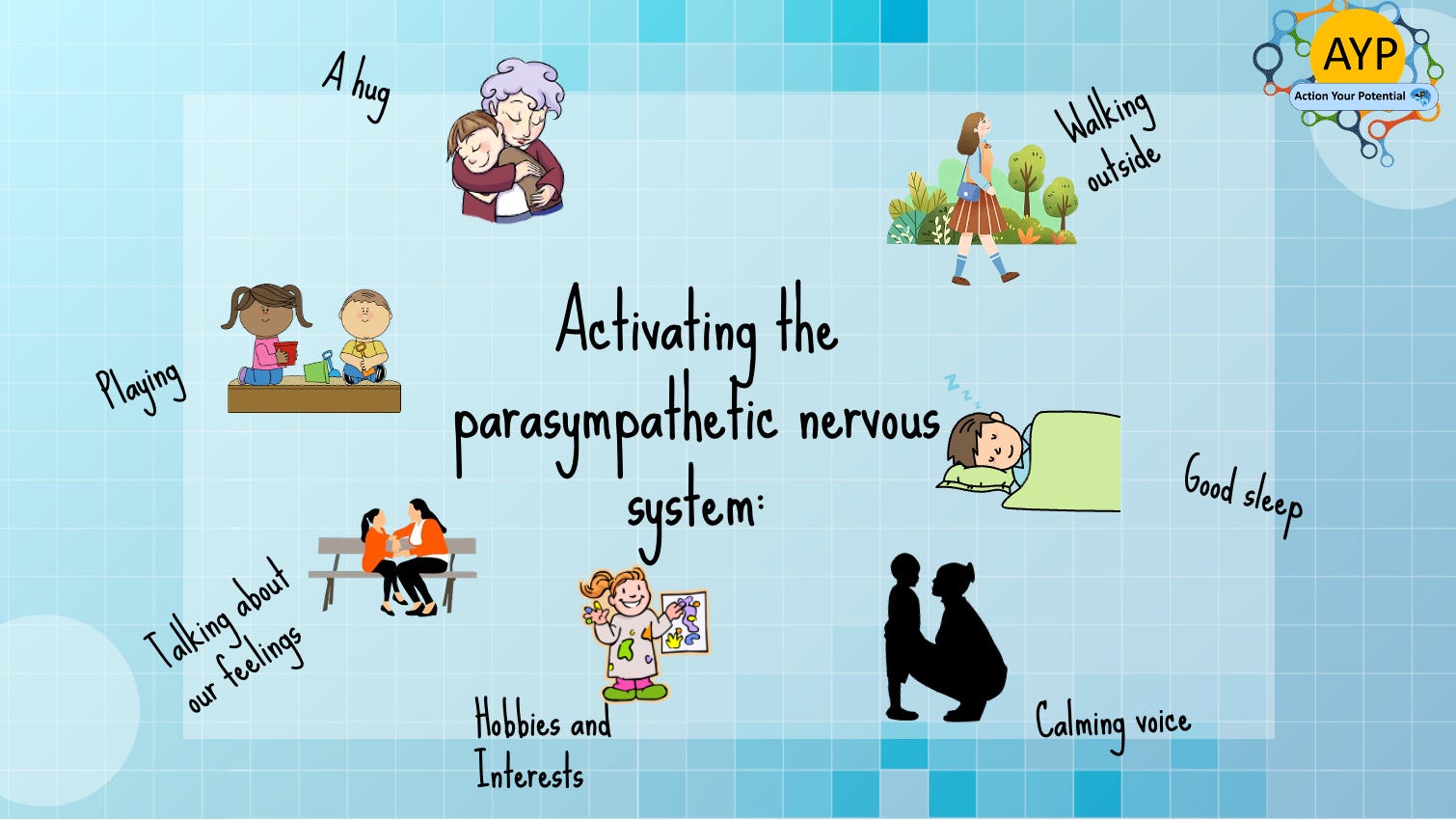
The driver of this regulatory system is the parasympathetic nervous system, the branch of the system that calms us down, enabling the body, brain and mind to recharge and recoup after the action-orientated demands of the sympathetic nervous system.
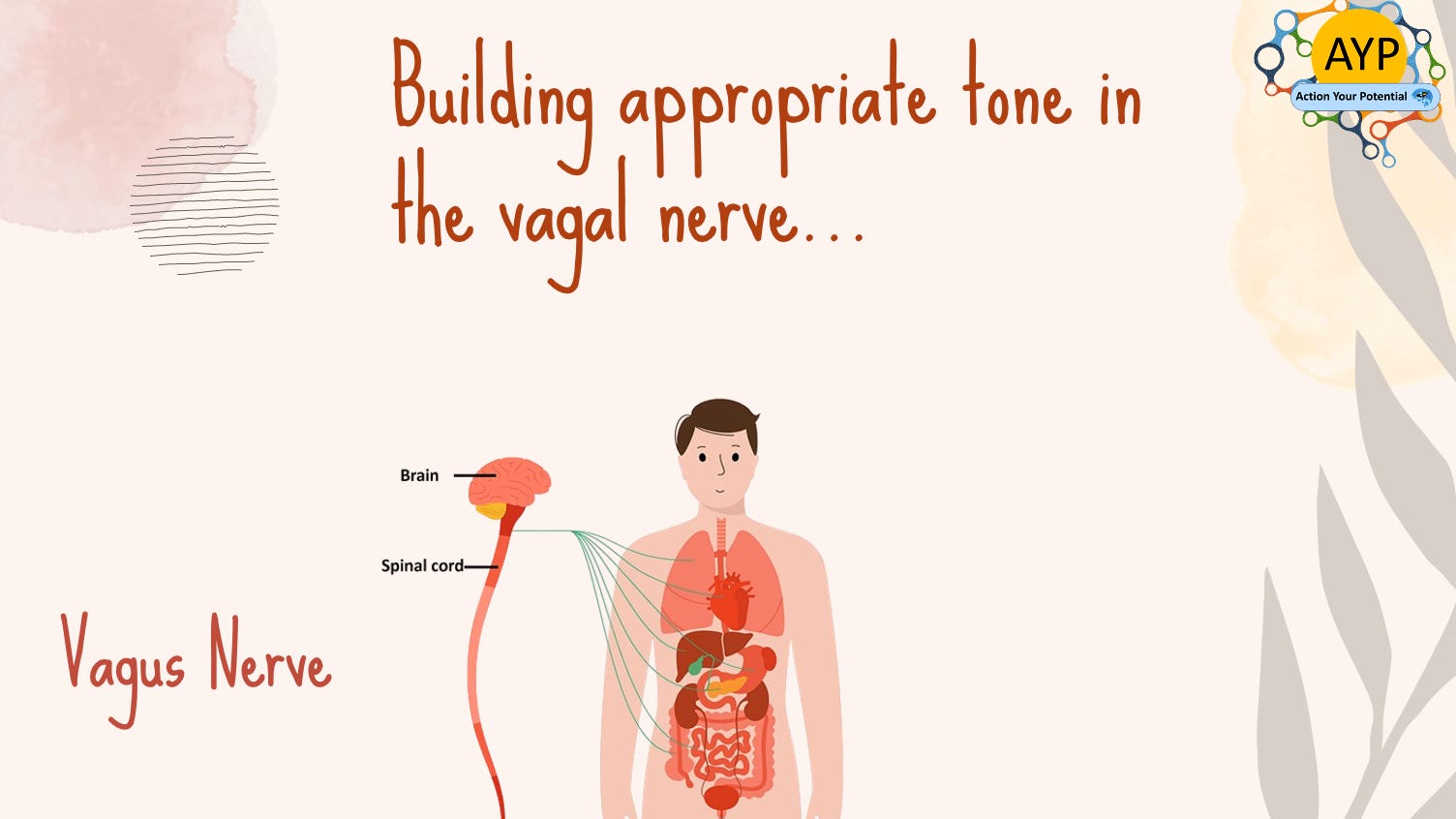
A significant component of our parasympathetic nervous system is our vagus nerve. The vagus nerve applies our physiological brake, it calms us down and returns us to balance.
Co-Regulation
Babies, as I’m sure you’re aware, have no regulation systems at all. But as we grow, babies become joined in a relationship of co-regulation with those closest to them. When we were babies, our parents and carers were doing most of the heavy-lifting within that co-regulation.
When we go to school the staff who support us will become partners in co-regulation and eventually our friends and our partners. Co-regulation relationships are a fundamental part of successful and healthy human relationships. No matter how good we get at self-regulation as an independent and autonomous adult we are always going to need relationships of co-regulation to help us manage the complex and unexpected ways the world will dis-regulate us.
Co-regulation is the interactive process through which a caregiver helps a child regulate their emotions, behaviours, and physiological states, especially when the child is overwhelmed or unable to do so independently.
It is a foundational concept in developmental psychology and is a precursor to self-regulation — the ability to manage emotions and behaviours independently.
Coping skills, but positive
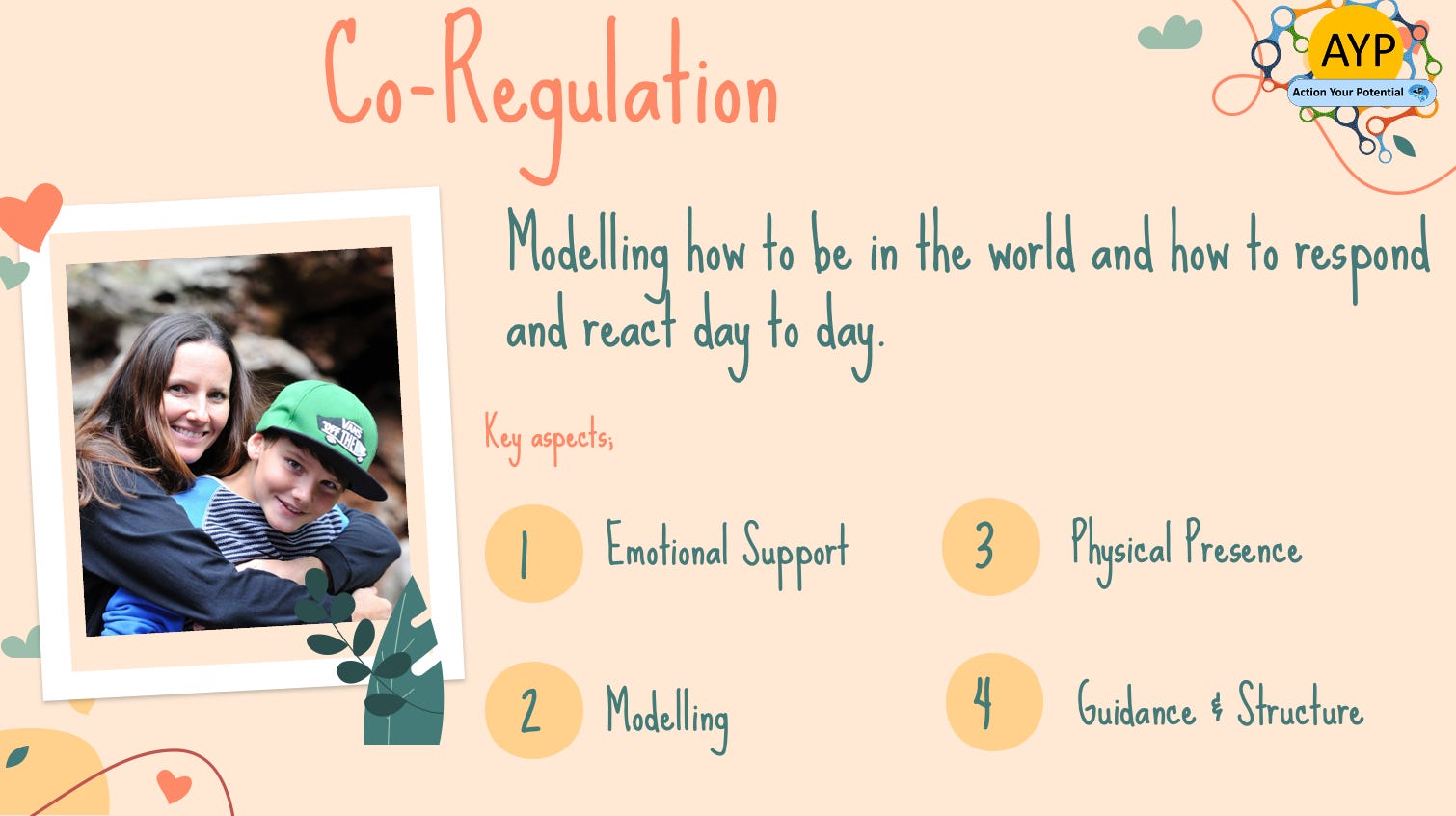
As we grow inside a loving and supportive parenting style – the authoritative style we focused on last week – we will learn positive coping skills.
Positive coping skills are the ability to strategically deploy activities in our days, weeks and months that will enable our brain, body and mind to return to balance through parasympathetic activation. Without these positive coping strategies, deliberately deployed, our body, brain and mind become subject to toxic stress.
Toxic Stress: the psychological and physiological pressure of being overwhelmed by challenges for which we don’t have the ability to respond.
Toxic stress can pitch our body, brain and mind into the state of frazzlement.
Frazzlement: an exhausted body, brain and mind where we lose our cognitive flexibility and we’re left experiencing maladaptive reactions.
These responses to stress are what happens when a body, brain and mind doesn’t practice positive coping strategies. Maladaptive reactions often manifest as extreme emotional reactions, such as: overreaction, moodiness, but they can also appear as physical ailments like back aches and chronic pain.
Positive coping strategies are skills we build through our development, therefore we learn most of them from our care-givers. Self-regulation is a skill learnt as a result of engaging in co-regulation with our care-givers.
Even as adults, when we are experiencing extremely challenging stressors, we will engage in co-regulation with our partners and close friends.
Steps in co-regulation development
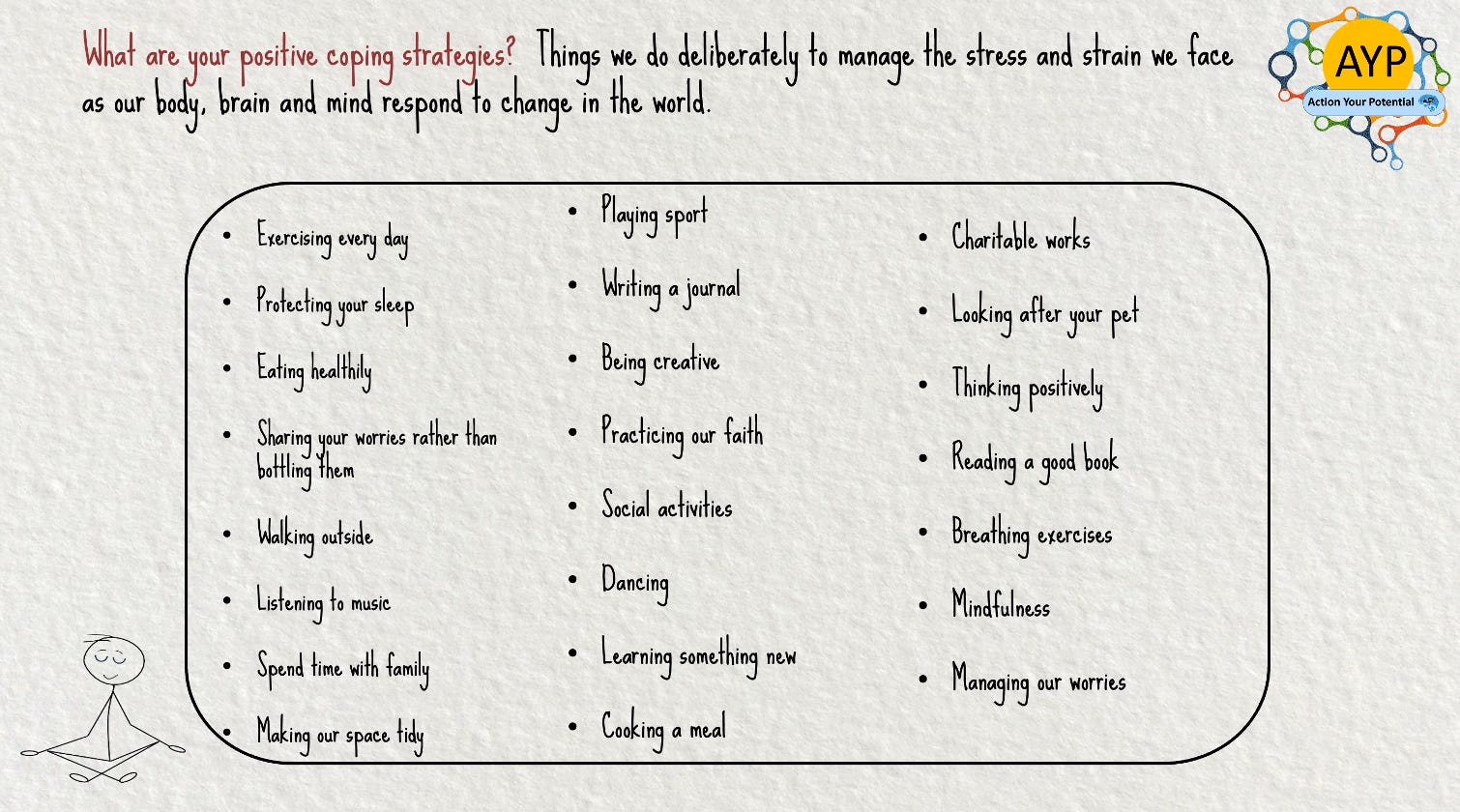
All four of the below activities of co-regulation begin life through serve and return interactions. These begin very early in a baby’s life, long before language develops. Smiling in response to a baby’s smile is a simple example of serve and return or playing peek-a-boo. Over hours, days, weeks and months serve and return interactions create the ongoing repetitions that supporting the building of our brains.
Emotional Support:
Caregivers provide comfort, empathy, and understanding to help the child navigate their emotional experiences.
Modelling
Adults model appropriate responses to stress or frustration, showing children how to handle emotions constructively.
Physical Presence
Sometimes, a soothing voice, a calm demeanour, or physical closeness (like a hug) helps to regulate a child’s state, this happens through the parasympathetic nervous system.
Guidance and Structure
Caregivers guide children by setting boundaries, offering strategies, or helping with problem-solving during challenging moments.
Why is Co-Regulation Important?
Foundation for Self-Regulation:
Co-regulation is critical for teaching children how to regulate themselves. When caregivers consistently provide support during emotional challenges, children internalise these processes and gradually develop the ability to manage their emotions independently.
Brain Development:
Children’s brains, especially the prefrontal cortex (responsible for self-regulation), are still developing. Co-regulation helps shape neural pathways that support emotional regulation, stress management, and impulse control.
Attachment and Security:
A caregiver’s reliable co-regulation fosters a secure attachment. Children who feel emotionally supported are more likely to trust others and form healthy relationships.
Stress Resilience:
Co-regulation helps children learn to calm down during stressful situations, reducing the risk of chronic stress and its associated negative effects on physical and mental health.
Social Skills and Empathy:
Through co-regulation, children learn to recognize emotions in themselves and others, building skills in empathy and interpersonal communication.
Emotions
Circuits in the prefrontal cortex, the front of our brain, help us process the world through feelings and cognition. Emotions are the brain interpreting the body’s reactions to experiences.
Parents and carers who practice authoritative, empathetic and loving care-giving support the development of their baby’s brain to learn, through co-regulation to recover from the surprises and shocks of being alive.
Top Three Tips (for co-regulating parenting)
Ensure children have experiences which are engaging, interesting and challenging but don’t overwhelm them.
Protecting children from experiences that would be overwhelming and traumatic.
Modelling self-regulation through their own actions as parents and carers and maintaining their own physical, mental and social health.
Due to the multilayered connection between a care-giver and their child, if the parent is under stress and strain, their child will be struggling as well.
Building Amazing Brains Webinars (March ‘25)
In these webinars Andrew Wright from Action Your Potential will offer all of our wonderful parents and carers a window on the world of the developing human brain. Being a parent is the toughest job in the world. The aim of these webinars is to help parents and carers to explore:
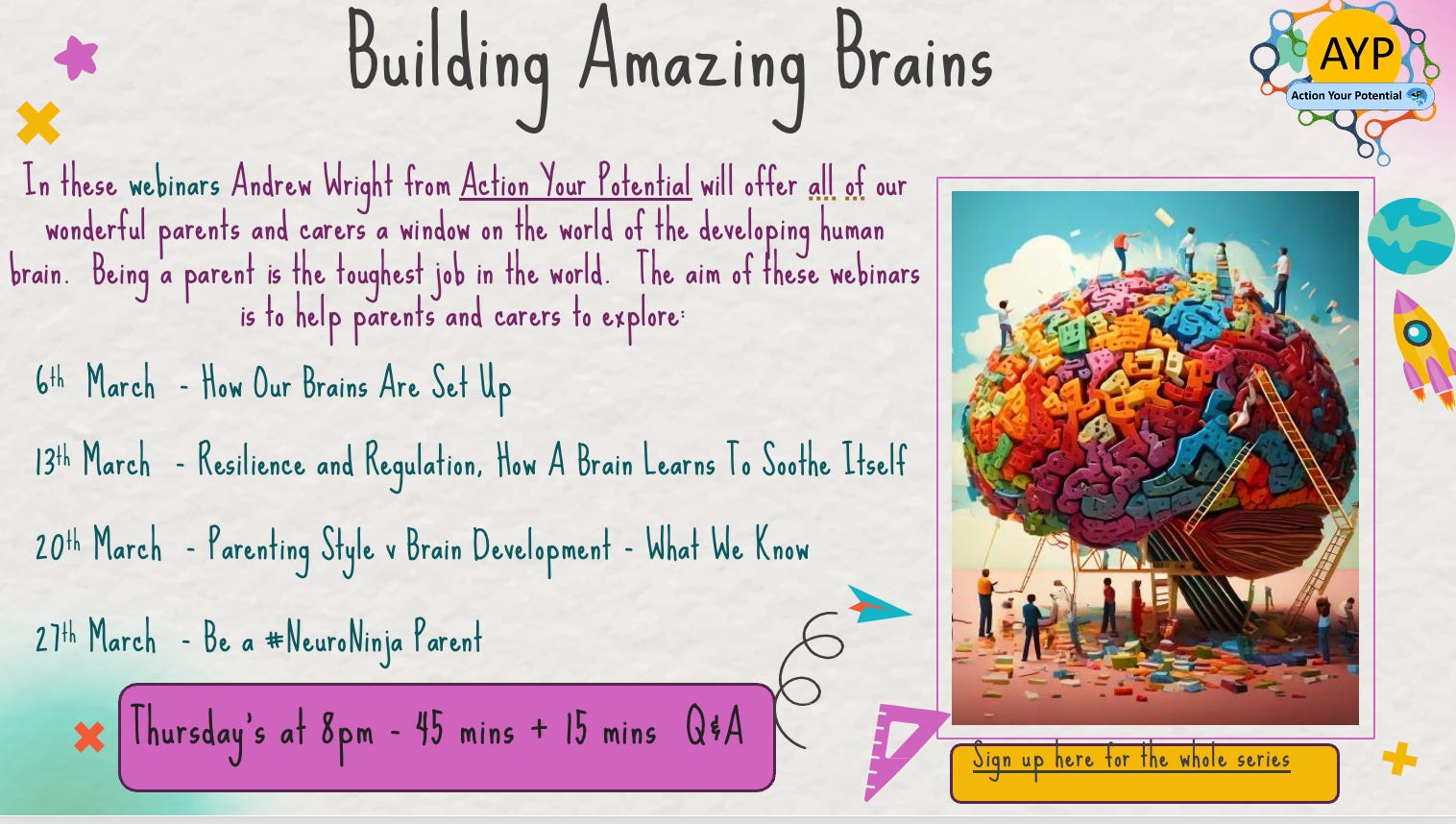
How our brain is set-up
The neuroscience of brain development
How to help their child to be resilient
How we can help our child first co-regulate and then self-regulate
How to parent for the long-term (for our child aged 40!!!)
How our own experiences as a child impact our parenting style
The webinars will each run on a Thursday throughout March.
Here's a video from Andrew at AYP explaining what we'll be looking at in this series.
Thursday 6 March 8pm (45 mins with 15 mins for Q&A)
Building Amazing Brains: How Our Brains Are Set Up
Thursday 13 March 8pm (45 mins with 15 mins for Q&A)
Building Amazing Brains: Resilience and Regulation, How A Brain Learns to Soothe Itself
Thursday 20 March 8pm (45 mins with 15 mins for Q&A)
Building Amazing Brains: Parenting Style v Brain Development What We Know
Thursday 27 March 8pm (45 mins with 15 mins for Q&A)
Building Amazing Brains: Be a #NeuroNinja Parent
Any questions about these webinars just email Andrew - andrewwright@aypuk.com. If your school doesn’t subscribe get in touch and we will contact them to see if they would like to. For individual parents and carers not part of a subscribing school you can access the series by subscribing to our Be A #NeuroNinja app.
Thank you for reading this edition of Neuro Ninja News! Every Wednesday we break down complicated neuroscience, right in your inbox.
Interested in learning more about our mission at Action Your Potential? Check out our websiteand our podcast!
Subscribe for free to receive new posts and please share this newsletter with your friends and family to support our work in changing the world, one brain at a time!
Any questions, comments or thoughts? We’d love to hear from you!
Please email us at andrewwright@aypuk.com or leave a comment below
This edition of Neuro Ninja News was written by Adam Wright. Edited by Andrew Wright.